Sunday, March 29, 2009

THANK YOU, BOB UNCLE!


Most of us probably don't spend a lot of time on where the waste from our home goes--I know that has not been high on my list of things to dwell on.  Here in India, however, that has been a continuing topic of thought, discussion, and finally action!  When we were home at Christmas, Ron casually mentioned to our son-in-law, Bob Tempest, that if he wasn't super busy with his underground pipe construction work in Salt Lake, he might consider coming to India and helping Ron watch the construction on the new buildings begin--kind of be a supervisor of sorts.  Bob agreed; it was a good time for him to leave for a few weeks and he thought that would be an interesting thing for him to do.  As the days moved toward the beginning of March when Bob was planning to come, Ron realized that with our supervisor that we had engaged to watch the materials, building processes, how the decisions were made by the contractor, that Bob would not have a needful job in that area.  HOWEVER, how would Bob feel about building us a septic system that would take care of all the waste from all the buildings (old and new) so that it never ran down our pathways in open ditches again!?!  (Also, so we would never smell it again.)

Hmm... Bob had never built a septic system before but he would get some books and study up on it before he got there.  Sounded like a good project to him.

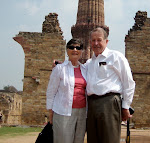
Sunday, March 29, Bob left Chennai on the train to Agra with his sister Lynne.  Lynne had come to spend a few days at Rising Star with us, and then would travel with Bob to Agra (Taj Mahal), the New Delhi area then on to Tokyo for a few days before returning home.  What he left behind at Rising Star Outreach was possibly the finest septic system in all of India.  He had accomplished the miraculous:  In three weeks time he had designed, mobilized an Indian labor force (none of whom spoke English except for the supervisor Victor, who spoke limited English), and completed a magnificent system that will serve us for years to come.  We're all still scratching our heads as to how he did this.  We did feed him a lot of good Indian food, so that probably helped his efforts. 

I'm going to give you the shortened version of the process, but if you're bored by septic system design, you can sign off now.  The RESEARCH began in the US for Bob--we had also been working with a Sanitation Engineer here by the name of Balusundaram.  Ron picked Bob up at the airport and went straight to his office.  They conferred, but Ron and Bob decided to modify the design Balusundaram had drawn and go with a system that is familiar to the U.S.

The system used includes a septic tank to hold solid wastes plus perforated pipe laid in gravel filled trenches for the effluent.  The bacteria disposes of solids, although periodic pumping is usually required.  The effluent is filtered through gravel and soil to become clean.

The DESIGN included the Field:  10 trenches, 3 feet wide, 5 feet deep, 100 feet long.  Gravel 3 feet deep would fill each of those 10 trenches, plus one trench that bisected and connected all of them down the center from the main connections.  Pipe: 4 inch perforated every 6 inches, all laid perfectly level. (Perforation was down with a power drill on site.)  Cover: Coconut leaves from the property laid on the pipe (no soil fabric in India).  Soil Cover:  2 feet.

They then connected to existing school and hostel drain lines, approximately 350 feet, and designed how the connection to the new school wing would be added on as well as the new volunteer hostel and dining/kitchen block when we are ready to connect.

Manholes (4 or them) were constructed to intercept and direct the effluent.  They also provide access to pipe for clean out or repair. Bob was continually working his calculations for the necessary size, elevations and required slope to insure drainage.
  
CONSTRUCTION-- a Backhoe (JCB as it is known here) dug all the trenches, placed gravel and back filled completed work.  Survey Instruments (which included mainly a string line and a survey tool--we had no levels), determined elevations to insure proper gradients for drainage and disposal.  Bob supervised All work:  directed the backhoe in the trenches, walking in front of it, calculated and verified proper grades, prepared the budget, and did hand labor himself as needed.  His Labor Force included 4 brick masons to build manholes, 3 men to spread and level gravel, 3 men to drill the perforations in the pipe and connect and lay the pipe, and cover with coconut leaves.  8 women to carry material and other work as required.  Our supervisor Victor arranged and supervised labor, along with Bob.

MATERIALS--?? tons of gravel (a lot!), 4" pipe (we perforated), 6" connecting pipe, glue, brick, mortar, concrete manhole lids (fabricated on site), coconut leaves (from property.) Tractor and trailer moved dirt and gravel.

TIME:  Friday night was the final hookup with the hostels (done late with flashlights when drainage was low.)  Saturday morning we had a celebration with a banner, children singing, and a couple of short speeches. There was the symbolic shovel of dirt into the smelly ditch to complete the ceremony.   It had been 18 days!!!  A miracle?  YES, but as with most miracles God often uses individuals to make things happen--Bob brought us a miracle.  Thank you Bob Uncle for sweet, healthy, clean air!


Saturday, March 21, 2009

Little Things I Love in India


There are many things about India that are hard--more importantly there are many things to love, particularly little things.  I will enumerate a few of these and illustrate with pictures if I can.

I love the way our driver Mani shows his displeasure when another driver does something really dumb.  Instead of using an obscene gesture (which I have never seen in India), or shaking a fist, or using a foul word, he lifts his left arm and gives a little twist to his hand with his fingers extended.  It looks so nice, but he's indicating "dumb" to the other driver.

I love our bug zapper--maybe we have these in the States, but I have never seen one.  You plug it into your outlet and when it is charged you switch it on and press a little button.  It has wires that have a charge and if a fly or mosquito fly into it, it makes a loud popping sound and that's it!  Good way to practice both your back hand and forehand for tennis or badminton.


I love our Security Guard that salutes us every time we pass him.  He use to click his heels also, but now he just salutes with a big smile, which is quite enough.


I loved watching Amy in the rice field so her photo could be taken with the beautiful green as a background.  Of course the rice field was wet and very muddy and she almost didn't return to the US--she did finally recover her shoes but they didn't look so great.  We really would have liked her to have stayed planted in the rice field--she looked great with her red skirt on.


I loved seeing our first "lady-fingers" (okra) from our garden.  It was a promise of more to come.


I love the designs the Indian ladies do for special occasions on the ground.  The one pictured was for Sports Day and was made with flowers and chalk.


I love the fact that boys play King of the Hill the world over.  All you need is a big pile of dirt and anyone can play. 
 

I also love little boys who pray so earnestly at mealtime they almost fall asleep. These children, regardless whether they pray to their Hindu God, Christian God, or Muslim God know where blessings come from and they are quick to express love and appreciation.  I hope I never forget to do the same. 

Thursday, March 12, 2009

Visitors at Rising Star Outreach - India


One of the most fun things that occurs at Rising Star is the arrival of visitors who come.  Over the months that we have been here many have come to volunteer their time and bless the lives of the children and the residents of the colonies.  We have some visitors who come for a day, and some who come to stay for days, weeks, or even months.  What a joy it is, when those who come unconditionally bring their willing hearts and helping hands.  Our biggest volunteer contribution comes in the summer months, when over a three month period volunteers of all ages come for one, two, or three weeks.  Over the summer we will once again have about 100 wonderful young people, and a few brave older souls, come to spend part of a hot and sweaty summer in Southern Tamil Nadu.  Those who come, have possibly never done anything as hard in their lives:  most leave feeling they have never had a more satisfying experience.  They all agree it is one that will never be forgotten.  

During our fall, winter and spring, volunteers who come do so with an understanding that they will have to be self-starters and bring a skill or talent to the table.  For instance, the Marriott Courtyard Associates come regularly once a month, bringing games, movies, cricket, advice and talk for our older kids, and always a wonderful meal.  There are usually 35 that come and often the manager and his wife come with their associates.  There is a scramble to be on the list each month, as there are about 250 employees at the Marriott and they all enjoy the day.  They bless the lives of the children, but ours as well, as the day is always one of joy.

This past week we had a family come--the Dad is tall--7' 6"!  It was the Shawn Bradley family who came to Rising Star out here in the middle of nowhere.  Dad and Mom, and four daughters, ages 10 - 14 were part of the full program of Rising Star.  They taught the children English in the mango groves; they went to the colonies to bandage wounds on feet and hands that have been severely compromised from leprosy and bless the lives of those whose blessings sometimes seem limited;  they played and taught basketball skills, volleyball moves and just played; they read stories to the children each night before the children retired. They participated in our annual Sports Day as the guests of honor.  They gave their hearts, and they lost their hearts to these beautiful children and their older relatives in the colonies.  It was a perfect picture of service given freely, and loving without limits.

The Bradley family, Grandma and Grandpa Thompson  and two grandsons, Julie Steed mother and cute daughter Taylor, Theresa Claugus, Bob and Jelean Montgomery, Kim McArthur and our dear Shaym Advani are but a few who have been here during these past weeks since we returned in January.  We are so grateful for those who come with a desire to help another--will they ever know the difference they make?  We surely hope so...

Wednesday, March 4, 2009

Bhutan


What a wonderful new country we discovered in Bhutan!  It's beautiful, has nice people, is extremely interesting, and not too hard to travel in.  The roads are hard; according to one source there is a curve every 9 seconds (some times it seemed more often to us), and the roads are narrow.  On the other hand, the population of the country is only about 600,000 so there are not tremendous numbers of vehicles.  Our accommodations were very pleasant, in one hotel we found a hot water bottle in our bed as we retired for the night!  Cold sheets are not my favorite, so that was very nice.  Our days were warm enough to be pleasant, our nights and mornings were frosty, but we had enough clothing to layer until it warmed up.  We spent the week with our dear friends of many years, Bob and Jelean Montgomery.  They are on an extended journey through Southeast Asia, and we felt lucky to join them for a few days in Bhutan.

Our one sadness was that we didn't see the Himalayas as our days where we might have viewed them the visibility that was limited with low cloud cover.  The one  beautiful mountain sight we had was of Mount Jomolhari, which at 24,000 feet is a magnificent backdrop for the Drukyel Dzong.  This mountain, which marks the frontier with Tibet, is sacred, as are all the mountains in Bhutan, and it is the dwelling place of the Goddess Jomo.  It was first climbed in 1937, but the expedition made it clear that is had not actually set foot on the summit.  Jomolhari has never been climbed since and it is now a 'protected peak.'  According to our guide book, Drukyel Dzong (a dzong being a fortress) was built on a rocky spur that blocks the Paro valley and protected it from invasions from the north.  The Dzong was built in 1647.  In 1951 a butter lamp fell over and started a dramatic fire, and only the walls remain.  There was a picture published in the National Geographic magazine in 1914 as it appeared before the 1951 fire.  In some ways, it was more fascinating in its burned out state, where we could better understand the layout of a Dzong.  The butter lamps have caused some terrible fires in the places of worships in Bhutan--Dzongs, temples and monasteries have all suffered some fire destruction.  They no longer use the butter lamps for their main source of light.  We did visit many beautiful dzongs, temples and monasteries that were still intact--most built from the 11th to the 17th centuries.

One of the most dramatic of these which did burn down but has since been rebuilt, is the Taktshang Lhakhang complex which sits at almost 10,000 feet above sea level.  In April 1998 Taktshang burned down, but the government rebuilt it and it was consecrated at the end of March 2005.  The buildings cling to the black rock, overhanging the valley below by 2600+ feet. The location is very impressive, and was not easily reached by us, as we had arrived only the day before from sea level.  It is one of the most venerated places of pilgrimage in the Himalayan world, and we felt very happy and proud of ourselves that we were able to accomplish this amazing climb and see and feel the sacredness the Bhuddhist people celebrate.

Bhutan has just celebrated 100 years of a continuous monarchy--5 kings, father to son.  The 5th king was crowned in 2006.  He turned 29 while we were there and we participated in 3 days of celebration for his birthday. We enjoyed a wonderful activity of dancing and speeches in Paro in his honor.  He is a very handsome young man, single, looking for his bride to be.  There are no arranged marriages in Bhutan, so the queen will be chosen by the new young king.  Bhutan is the newest democracy in the world--6 months old.  They are slowing setting up the parliament and all the ministers, with the king actively taking a part in it all.  There is pride in their monarchy, but also in this new democracy they are working on.

Buddhism is the religion of the country.  Their worship is part of their daily lives, and tradition in their dress and their culture is very evident.  The monks (of which there are about 6000 at present) are taken care of by the state.  They live in dzongs and monasteries and wear the characteristic dark red robe.  They take care of all the religious sites, including the temples.  A child will usually begin their training to become a monk at about 6 or 7 years if age.  Buddhism first came to Bhutan in about the 8th century, but really took hold in the 11th and 12th centuries.  It seems to be a gentle religion which affects the people of the country--speech, actions, etc.  

Bhutan separates China from India--two powerful neighbors, and the Bhutanese are proud of the fact that they have never been conquered by anyone.

One thing we loved seeing was the countries national animal--the Takin.  It is part goat, part cow, and has a wonderful story that goes with it about how this came about!  Ask us about it sometime.

There is so much to tell, but hopefully a few pictures will explain more.  We loved our journey and would recommend it as a travel destination.


Monday, February 16, 2009

We've Started!


It's true--we have actually started digging.  What an exciting day for all of us.  We have in place the temporary housing for the workers, the land has been cleared, and the puja (religious ritual) was performed.  The marking of the building was done and indicated with posts and strings.   The contractor has rented a home in a nearby village and yesterday we were invited to the blessing on his home. We had to be present at all these occasions--in fact this morning we found them waiting for us before they took the first ground up.  

The first shovelful was dug at exactly 9:30 a.m.  A big digger can move quite a bit of dirt and as the day progressed there were large holes the whole length of the school for the foundations.  It was fun to see how many bosses there were standing around watching the progress.  Everyone likes to be the boss--and with that job you stand around a lot.

We have begun on the school first since we ran into some numbers on the bid, which substantially raised the cost of the volunteer hostel.  We think with a bit a redesign and taking off some frills, we are back in line with our original estimates.  At this point we are a little gun-shy to say the least.  Many things that would be included in a bid price at home are not included here.  Some are very important, like sewer, water, electrical, etc.  We have seen the surprises that can occur with foreigners who think the system works like their own.

Ron and Joyce are leaving tomorrow for Bhutan to spend a week exploring with their friends from home, Bob and Jelean Montgomery.  We will send pictures and tell you a bit about it when we return.

Sunday, February 8, 2009

Mani's Auto Rickshaw and Friends!


Mani, our oldest and best driver, used to make his living carrying passengers in his auto rickshaw.  Auto rickshaws are the primary source of moving paying customers in Chennai. They have three wheels, a smelly diesel engine, and are built to carry three passengers.  We have, however, seen as many a ten in one vehicle.  They also are an incredibly cheap--sixty cents from the store six blocks away to our apartment building and that is without any bargaining. You can distinguish an auto rickshaw when they come from behind by their squeaky horn sound.  Two wheelers (motorcycles) sound like wounded ducks while the big buses are the gigantic tuba players.  Everyone moves away from buses.  Our Tata Sumo jeeps make a nasty, unpleasant sound.  The bicycles only tinkle.  Chennai is a city of deafening vehicle horns amidst an anarchy of traffic.

Mani has now retired his auto rickshaw to a side path amongst our beautiful coconut trees.  He drives regular cars and vans, so his auto rickshaw has become surplus.  It is fun to drive, but mostly it just sits too close to the trees around it.  For awhile, the children were interested in exploring its innards.  That curiosity, however, passed and so day and night it has had no visitors.  It is sad to be so neglected and lonely.

Then, a new family from the coconut trees moved onto our campus.  It may be the same family that has been around for awhile, but since monkeys tend to look alike, we could not be sure.  At any rate, they found Mani's auto rickshaw and fell in love with it.  I think they made Mani's auto rickshaw feel much better.  You can see why.  They play on and in it.  They are even more curious than the children, and best of all--they discovered a new use.  Everybody, even a monkey, needs to feel good about how he looks.  Now Mani's auto rickshaw is once again in service.  It is the place where the monkeys can come and check on their appearance before heading back up into the trees to start throwing the heavy coconuts at us.  Mani's auto rickshaw is happy again.

(Photos by our volunteer Theresa Claugus)

Tuesday, February 3, 2009

A Symphony in Green!


Last Saturday was our rice planting day--we were mesmerized watching a tradition centuries old, repeated in our very own back yard.  We have two large fields we have planted in rice--we were to plant four, but one will become the leach field for the septic system, and part of the other one will have a bit of the new school wing interfering.  It's still a big area, and will provide us with rice for a year and some to sell in the market.  

The day began with a snake--auspicious or not??  Not sure, but the guys got in the power box near the water pump and there he was.  They promptly disposed of it--they're not ever likely to think will this snake hurt anyone, or does it do more good than harm?  It was quickly dispatched.

The field has been flooded for a couple of weeks in preparation for the planting.  The first thing that occurred on Saturday morning was the arrival of a pair of oxen and the driver, with a board dragged behind.  He went through the entire area to be plugged with the rice, smoothing the bottom beneath the surface of the water.  At the same time, one man was tying bunches of the rice that has been growing in the "rice nursery," while 3 of our guys carried the wet, drippy bundles to distribute evenly in the wet area.

The women were sitting under the trees waiting until there were enough bundles for then to begin.  There were eight women, colorfully dressed in their saris, which they tucked up above their knees to keep from getting in the muddy water as they did their planting.  It took them from 9:00 a.m. until 5:00 p.m. to plant the two fields.  It was done in a beautiful order, starting at one side of a field at the edge, and moving backwards until they had plugged each individual rice plant into the water.  They moved back to the start of that same field and did it again, working almost in unison. They are bent over for hours--back breaking--but so beautiful to watch.  I wanted to try it, but the snake deterred me a bit!

The rice will be harvested in three months--in the meantime, we will watch the plants grow and the field fill in.  As mentioned in a previous blog, a rice field is God's green.